Welcome to Merida Yucatan Mexico
                                 
  home contact us Español English
LODGING
  BARS AND RESTAURANTS SERVICES   INTERESTING INFORMATION
Lodging     Bars and Restaurants  
Emergency Phone Numbers Travel Agencies Hospitals and Medical Services Airlines
 
 
MERIDA
OUR TRADITIONS
CULTURAL EVENTS
Live a Meridan Week
INTEREST POINTS
 
Music
 
Our traditions / Music
The Jarana Orchestra  

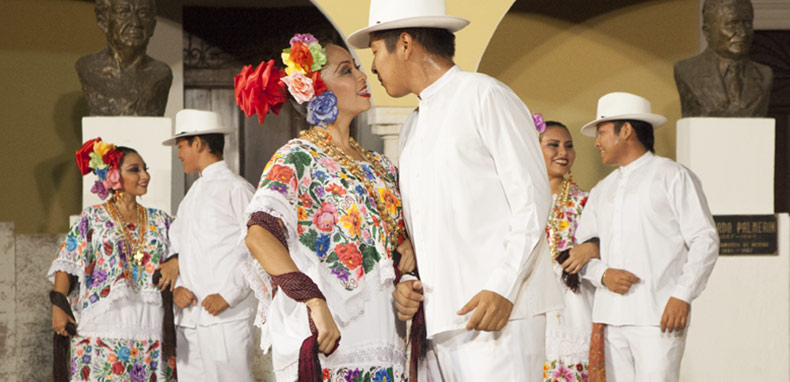
Jarana orchestras serve a triple function in village festivals: they play in “vaqueria” dances, accompany Patron Saint processions and provide the musical background for bullfights. These orchestras, known as “charangas” in many villages (the term describes a small wind instrument ensemble), originally consisted of two trumpets, two clarinets, a double bass, a saxhorn (which was later substituted for a tenor saxophone), a “guiro” (a dry gourd with numerous slits, stricken with a thin stick to make a scratchy sound) and two “timbales” (tropical music kettledrums).

“Timbales are the soul of balls; when a local plays them, he infinitely varies their rhythms and accents, and there are moments (for instance, when a couple distinguish themselves by their dancing skills and the others dance around them in a circle) when all dancing is done to the sole tune of timbales. The reason for having two of each instrument is that, with jaranas being danced almost continuously for several hours, musicians need to take turns every now and then, if they are to avoid getting tired before dancers do (Fernando Burgos Samada “La Musica Actual de los Indigenas de Mexico”. 1934).

Music

“Some modern orchestras use three trumpets to give the jarana an even more vibrant sonority, and the double bass has been substituted for an electric bass guitar”

From the book “Costumbres de Yucatan” by Luis Perez Sabido. 1st edition. Merida, Yucatan. 1981. Chapter VII, page 68

Jarana: its musical characteristics

Jarana is the traditional dance of the Yucatan peninsula. Depending on their time signature, there are two kinds of jaranas: The “6/8 jarana” and the “3/4 jarana”. The 6/8 jarana (played to a 6/8 beat) is a tap dance (“zapateado”) that descends from old Andalusian tunes and mestizo “sones”. It is a lively dance which follows a two-step tempo and whose rhythmic accent falls on the second third of the bar’s weak beat, on a note that can be lengthened to the last third or syncopated until the first third of the next bar. The 6/8 jarana is characteristic because the second third of the strong beat in odd bars is reinforced by a higher appoggiatura of mayor or minor second. In recent times, this peculiarity has stopped being reflected in scores, but it is nevertheless heard in performances, as musicians always play it intuitively as an ornament.

The 3/4 jarana emerged later on. This is a waltz-like rhythm reminiscent of the Aragonese folk songs known as “jotas” from which it descended; hence its time equivalent to 84 dotted half-note. Originally, 3/4 jaranas were just instrumental music played in dances, but later on rhymed texts were included, either by adapting lyrics to pre-existing scores or by composing melodies to match festive verses. An example of this is Manuel Burgos Vallina’s “La fiesta del pueblo” (The village’s festival). Composing jaranas including both rhythms in a single piece (a first part to 3/4 beat and a second one to 6/8) became common over the course of the 20th century. A couple of examples are “Mi lindo Motul” (My lovely Motul) by Armando Gonzalez Dominguez and “La morena de mi pueblo” (The dark-skinned girl in my village) by Manuel Gil Lavadores.

Listen to the following musical pieces:

(These audio samples are in .wav format and can be listened to on Windows Media Player)

Pasacalle: "La Angaripola"
Common knowledge
Performed by: Jarana Orchestra of the City Council of Merida, Yucatan, Mexico.

Jarana "Mimi Ginés"
Arrangement by: Jose I. Bojorquez
Performed by: Jarana Orchestra of the City Council of Merida, Yucatan, Mexico

Guaracha: "Mujeres que se pintan"
Composed by: Cirilo Baqueiro Garcia Rejon
Performed by: Jarana Orchestra of the City Council of Merida, Yucatan, Mexico
Jarana " Aires Yucatecos"
Composed by: Nicomedes Canto y Canto
Performed by: Jarana Orchestra of the City Council of Merida, Yucatan, Mexico
 
Pieces taken from the second edition of the record “Jarana Orchestra of the City Council of Merida”.
City Council of Merida
 
 
The official site of the Merida Tourism Office, City Government of Merida, Yucatan, Mexico. Calle 59 between 52 and 50, Downtown Area. Phone: (999) 928-19-66 and 924-73-81. Email: turismo@merida.gob.mx