Welcome to Merida Yucatan Mexico
                                 
  home contact us Español English
LODGING
  BARS AND RESTAURANTS SERVICES   INTERESTING INFORMATION
Lodging     Bars and Restaurants  
Emergency Phone Numbers Travel Agencies Hospitals and Medical Services Airlines
 
 
MERIDA
OUR TRADITIONS
CULTURAL EVENTS
Live a Meridan Week
INTEREST POINTS
 
Traditional Attire
 
Our traditions / Traditional Attire


Among the Yucatecan handcrafts that the Spanish colonizers most appreciated were the woven cotton blankets made by the Maya. They were of such quality that they came to constitute a major part of tributes claimed by the “encomenderos”, Spaniards who held Crown-granted rights over the indigenous population of a certain area. However, the traditional attire of Yucatan (“hipiles” and “ternos” for women and “guayaberas” for men) resulted from adaptations of elements from the most diverse sources and the mixing of cultures, techniques and materials.

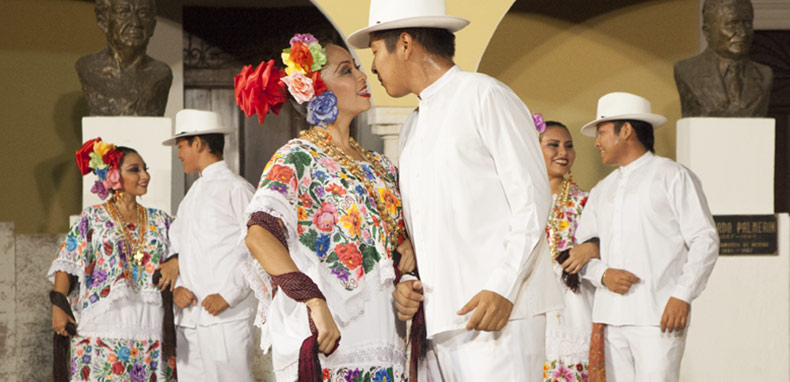
The tailoring of a “terno”, the traditional formal attire of indigenous women (locally known as “mestizas”), is a process involving about 6 months of painstaking hand-made embroidering to achieve the garment’s magical combination of colors. Such skilled work makes of each terno a true masterpiece.

Traditional Attire

The term “terno” comes from the fact that these dresses consist of three pieces. The first one, known as “jubon”, is a wide, flat, richly embroidered square flounce that is attached to the neckline of the second piece, the hipil. The latter is a white, knee-high square dress, with embroideries and a lace-trimmed hemline. The third part, called “fustan”, is a long, straight waist-slip, which is worn under the hipil and is also embroidered and lace-trimmed. All the embroideries are done using a technique known as cross-stitch.

A terno is complemented by a special kind of Mexican shawl, known as a “rebozo de Santa Maria”, after the village where they are made. The color of the rebozo is chosen to match that of the terno’s embroideries.

Traditional Attire

Yucatecan embroideries date from pre-Hispanic times, as proven by the discovery of pieces of embroidered garments at the bottom of Chichen-Itza’s sacred well. These embroideries were made using the “chuy cab” or satin-stitch technique. Other Mayan embroidery techniques still used to this day are the cross-stitch or “xocbil chuy” and a kind of openwork known as “xmanikte”. Among the most popular stitches are the filling stitch, shadow stitch, Renaissance stitch, lattice stitch and openwork. These techniques are usually passed from mother to daughters within households.

The men’s shirt known as “guayabera” is a development of the one-piece shirts made of rough cotton fabric worn by Cuban and Mayan peasants.  With time, these shirts became more elaborate and elegant, including thin pleats, pockets, buttons, and even embroideries of geometric patterns.

Traditional Attire

Indigenous men (mestizos) wear an elegant ensemble consisting of white flat front pants and a white “jacket” or “filipina”. The latter is a white cotton, long-sleeved, Nehru-collared, pleated shirt. In addition, a large red scarf (known as “paliacate”) is left to hang from one of the pants’ pockets, and the attire is completed by a white Panama hat (locally known as “jipi”).


The official site of the Merida Tourism Office, City Government of Merida, Yucatan, Mexico. Calle 59 between 52 and 50, Downtown Area. Phone: (999) 928-19-66 and 924-73-81. Email: turismo@merida.gob.mx